How to Journal With Tarot Cards Every Day, Plus 12 Questions for Any Card

To journal with tarot cards every day, pull one card at the same time each day, look at the picture for a minute, and write a few lines about what you notice and how it connects to your life. Keep each sitting small, with two or three questions at most, and the meanings of the cards start to stick on their own.
I do mine in the evening, sitting on my bed with my deck and a notebook. Below is the routine I follow and 12 questions you can ask any card when you don’t know what to write.
What is tarot journaling?
Tarot journaling means using a tarot card as a writing prompt. You pull a card, look at the picture and write about how it connects to what is happening in your life right now. Nobody else needs to read it, and there are no wrong answers.
I use the cards as a tool for thinking and reflecting. A card points my attention somewhere, and the writing is where I work out what it means for me that day.
It’s also one of the easiest ways to learn tarot. A full deck has 78 cards, and reading about them in a book only takes you so far. When you meet a card on an ordinary Tuesday evening and write about that Tuesday, you remember it.
What do you need to start a tarot journal?
Very little. You need:
- A tarot deck you enjoy looking at. You’ll be spending time with the pictures, so pick one you like.
- A guidebook or a learning deck. As a beginner, it helps to have the meanings close by.
- A notebook and a pen. Any notebook works; a small one that stays with your deck is easiest.
- Ten to fifteen minutes.
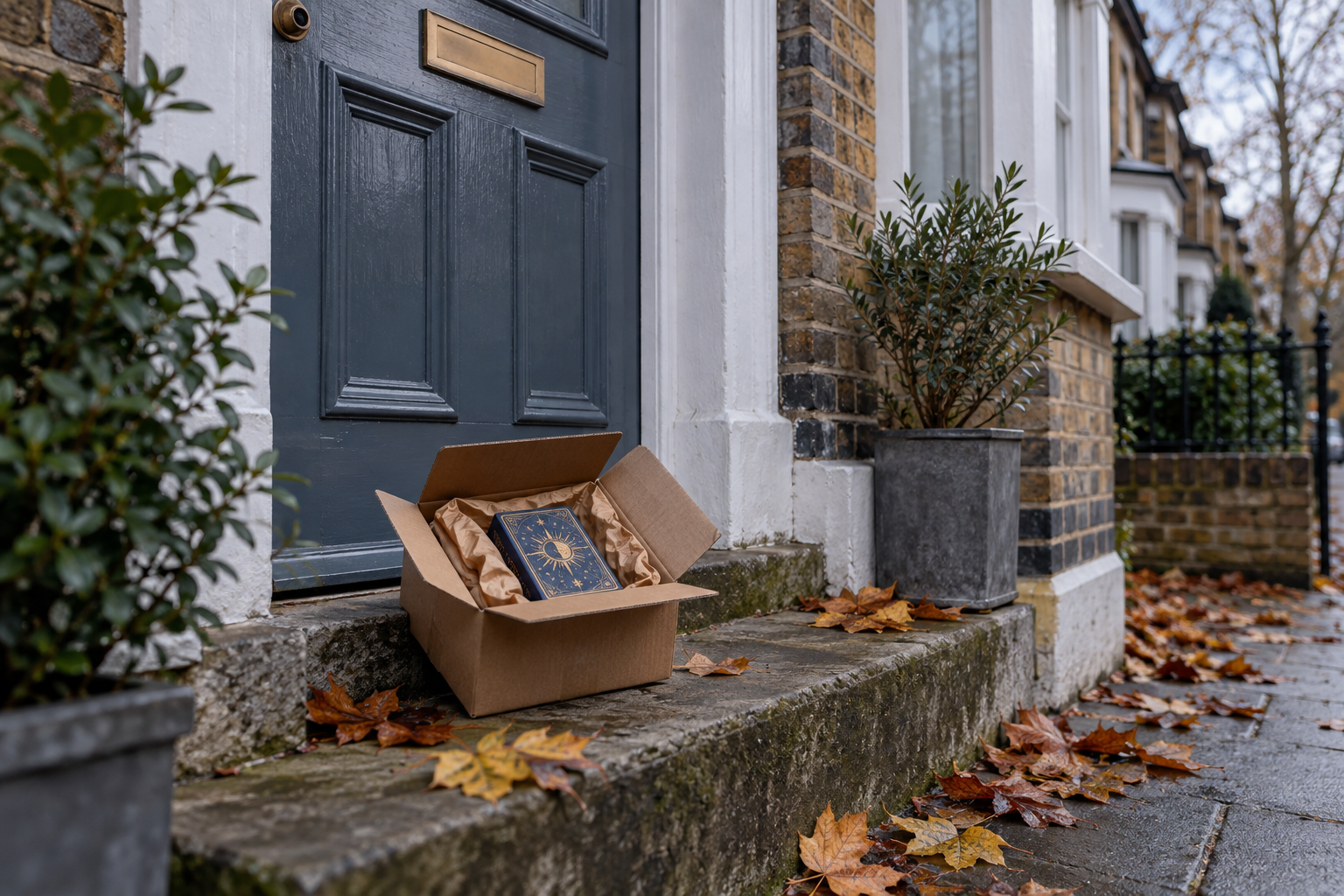
I found my own deck almost by accident. It came as a set of two: a beautiful shiny gold deck and a smaller learning deck with the meaning written on each card. Having both in one box was the best part for me as a beginner. I ordered it online from the USA and waited three months for it to arrive in England, so if you’re still waiting for your deck to turn up, you’re in good company.
There are plenty of rules online about how to shuffle and lay out tarot cards. Choose a way that feels comfortable in your hands, or make up your own. Your deck won’t mind.
A simple evening tarot routine, step by step
This is how a normal sitting looks for me. Fifteen minutes is plenty.
- Sit somewhere comfortable. My spot is the bed, in the evening, once the day is finished.
- Write the date and two or three questions at the top of the page. For example: What do I need to notice this week? What is helping me at the moment?
- Shuffle and pull one card for each question.
- Look at the picture before you read anything. Write down the first thing you notice, even if it seems small.
- Check the meaning in your guidebook or learning deck. Write a sentence or two about how it fits your question, or where it doesn’t fit.
- End with a card of the day. I finish every sitting by pulling one more card just for learning and writing down its name and meaning. You can carry it with you into the next day and notice where it shows up.
If your evenings are already full after work, my slow evening routine for when you work full time shows how a small ritual like this can fit in.
Why two or three questions are enough
I’ve noticed that when I ask the cards lots of questions in one sitting, the answers stop making sense and I end up with a page of nonsense. So now I prepare two or three questions before I sit down, and I stop there.
Fewer questions leave more time for each card, so you can look at it properly and still finish before you get tired.
The same goes for pulling again when you don’t like a card. It’s tempting to slip it back into the deck and draw another, and then another, until something nicer turns up. By then you’re only reading what you hoped to see. Write about the card you pulled, even the uncomfortable ones. If the Death card turns up and makes you nervous, my guide to the Death card for beginners explains why it rarely means what people fear.
How a daily card helps you learn tarot meanings
One card a day is the simplest way to get to know the whole deck. Over a few weeks you’ll meet many cards more than once, and each time you’ll add something new to what you know about them.
A small tip: keep a page at the back of your notebook for a list of the cards you’ve pulled. Next to each one, write a few words about what it means to you. After a month, that list becomes your own personal guidebook.
If the hard part is keeping the habit going, my 5-minute journaling habit has a few ideas that work just as well for tarot.
12 questions you can ask any card

When I don’t know what to write about a card, a question helps. You don’t need all twelve. Pick one or two that fit the card in front of you.
- What is the first thing I notice in this picture?
- Which colour stands out to me, and how does it make me feel?
- Who or what in this card do I relate to most?
- What is the figure in the card doing, and what might they do next?
- Where does this card show up in my life right now?
- What is this card asking me to pay attention to?
- What would change if I followed this card’s advice for one week?
- What feels uncomfortable about this card, and why?
- Does the written meaning match my first impression? Where is it different?
- What does this card remind me of from my own past?
- What is one small thing I could do tomorrow because of this card?
- If this card could speak to me, what would it say in one sentence?
Cards full of symbols are good for practising these questions. The Moon card is a lovely one to start with, because there is so much to notice in it.
A three-card spread for when one card isn’t enough
Once daily cards feel familiar, you can try a simple spread with three cards. Lay the first card in the middle, the second to its left and the third to its right.
- Middle card: the heart of the situation or question.
- Left card: what led to it, such as the background or past influences.
- Right card: where things seem to be heading.
Read the middle card first, then the two beside it, and write a short paragraph about how they connect. Count this spread as one of your two or three questions for the evening, so the sitting stays small.
A few questions
Can I start tarot journaling as a complete beginner?
Yes. Daily journaling is one of the easiest ways to begin, because you learn one card at a time. Keep a guidebook or a learning deck nearby and check the meaning after you’ve written your first impression.
Is it better to pull a card in the morning or in the evening?
Either works. I pull mine in the evening, which suits looking back on the day. A morning card is something you can carry through the day ahead. Pick the time you’re most likely to keep.
What if I pull a card I don’t like?
Write about it anyway. Ask yourself what feels uncomfortable about it and what it might be pointing to. Pulling again until you like the answer makes the practice less useful.
How much should I write?
A few lines is enough. The date, the card, your first impression and one sentence about your day make a complete entry.
Tarot journaling grows one card at a time. Start with tonight’s card and a couple of lines, and see where the notebook takes you.
If you’d like more small rituals like this one, join the newsletter for new stories and free printables.
With warmth, Zeny